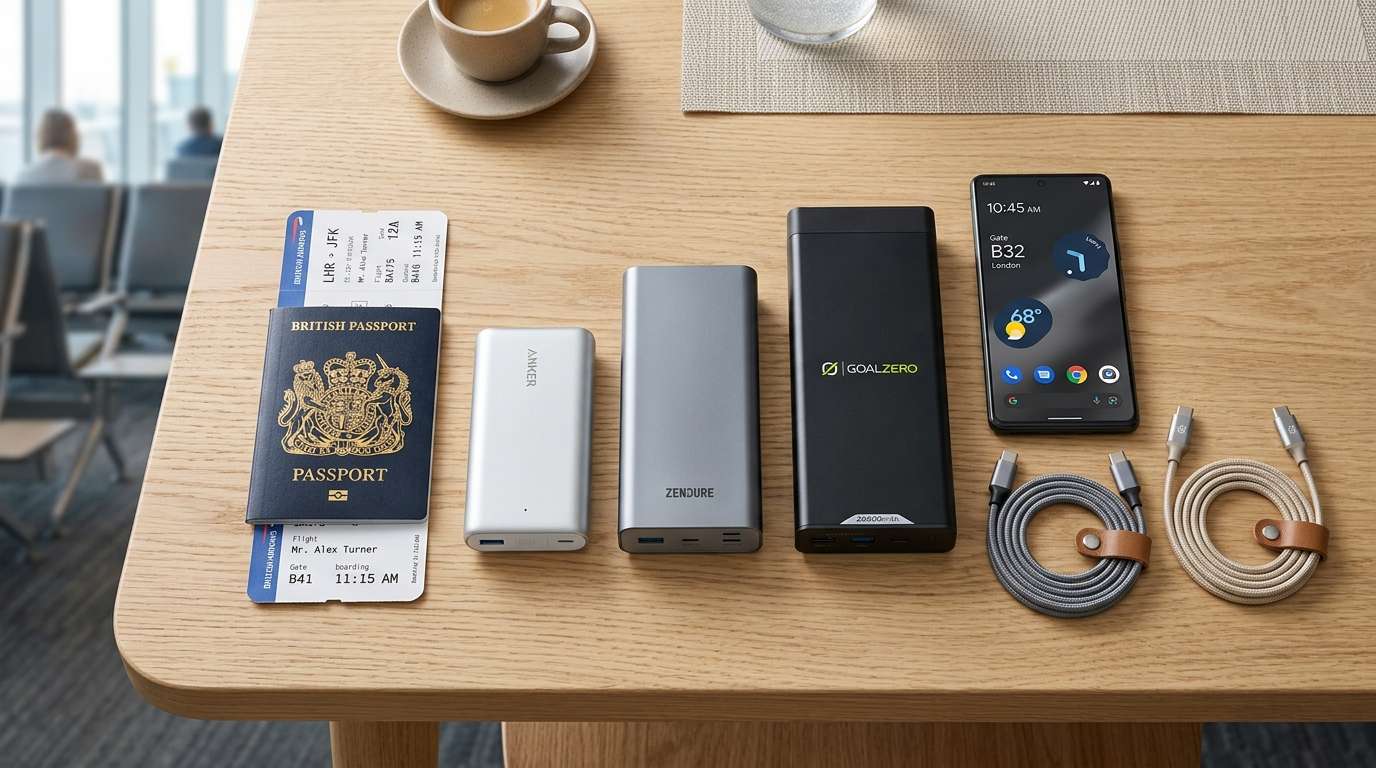
You know the feeling. You’re twenty minutes from your gate, your phone is sitting at 4%, and the only outlet in sight has three other travelers camped around it. A decent power bank fixes that problem before it starts — but figuring out which one is actually worth buying in 2026 takes some sorting through, since most “best of” lists just repeat the same five products without explaining why they made the cut.
This guide skips the noise. Below, you’ll find what’s genuinely changed about travel power banks this year, a simple framework for picking the right capacity and wattage for your trip, a set of specific product recommendations for different travel styles, and answers to the questions people ask most before buying one.
What’s Different About Travel Power Banks in 2026
A few real shifts are worth knowing about before you shop:
Airline carry-on rules are getting stricter about handling, not just size. The 100Wh capacity ceiling for carry-on power banks hasn’t changed on most airlines, and checked luggage is still off-limits for these devices entirely. What has shifted is how airlines want you to use a power bank mid-flight. A growing number of carriers are asking passengers to keep their power bank within reach rather than stowed in an overhead bin, and a few U.S. airlines have started capping how many units one passenger can bring on board. None of this stops you from traveling with a power bank — it just means it’s worth a quick check of your airline’s current policy before departure, since the rules are still settling.
USB-C fast charging is no longer a bonus feature — it’s the baseline. A power bank without solid USB-C Power Delivery output feels outdated fast in 2026. If you’re mainly charging a phone, look for at least 45W. If a laptop is part of the equation, you’ll want 65W or higher to see a real difference.
Two USB-C ports beat one USB-C and one USB-A. Most devices worth fast-charging have moved to USB-C, so a bank still built around a USB-A port is starting to feel like a relic.
Battery percentage screens have become the norm on better models, finally replacing the frustrating four-dot LED guessing game.
How to Choose the Right One for Your Trip
Skip the spec sheet for a second and answer three questions first.
1. How much capacity are you actually allowed to bring?
Airlines calculate the limit in watt-hours, not milliamp-hours, using this formula: watt-hours equal milliamp-hours divided by 1,000, multiplied by 3.7. That’s why you’ll rarely see a “travel” power bank marketed above 26,800mAh — it lands just under the common 100Wh cap. For reference, a 25,000mAh bank works out to roughly 92.5Wh, and a 20,000mAh bank to about 74Wh. Both leave you comfortable room under the limit.
2. What are you actually going to charge?
- Phone only, short trip: 10,000mAh covers roughly two full phone charges, which is plenty for a weekend.
- Phone and tablet, multi-day trip: 20,000mAh gives you enough of a buffer without adding much bulk.
- Laptop in the mix: Start at 20,000mAh minimum, but shift your attention from capacity to wattage — a laptop needs real power delivery to charge meaningfully, not just a big battery.
3. How fast do you need that charge to happen?
If you’re the type who tops up during a rushed layover rather than overnight, wattage matters more than the mAh number on the box. A bank capped at 10W or 15W barely makes a dent in fifteen minutes. Something at 45W or above will visibly move your battery percentage in the time it takes to clear security.
One more feature worth hunting for: pass-through charging. This lets your power bank charge a connected device while it’s plugged into the wall itself, which is genuinely handy in a hotel room with exactly one working outlet and three things that need power.
The Best Travel Power Banks in 2026, By Use Case
Best Overall: Anker Prime Power Bank (20,000mAh, 220W)
This one earns its spot by behaving less like a battery and more like a mini wall outlet you can carry in a backpack. It spreads 220W of total output across two USB-C ports and one USB-A port, and a single USB-C port alone can push up to 140W — enough to fast-charge a demanding laptop while still leaving power for a phone or tablet on another port. At 20,000mAh, or about 74Wh, it clears airline limits with plenty of room to spare, and it’s the pick we’d recommend if you only want to buy one power bank and have it cover almost every situation.
Best for Maximum Legal Capacity: Anker Prime Power Bank (26,250mAh, 300W)
If your goal is squeezing every legal watt-hour out of your carry-on, this is about as close as you can get to the 100Wh ceiling — it comes in at roughly 99.7Wh. It backs that capacity with 140W max fast charging and a small onboard display that shows exactly how much charge is left, which is a nice touch on long-haul flights where you’re rationing power across a full day of travel. Two built-in USB-C cables also mean fewer loose cords floating around your carry-on.
Best for Business Trips: Anker Laptop Power Bank (25,000mAh, 165W)
Built with multi-device charging in mind, this model runs three separate 100W USB-C ports and includes retractable built-in cables, letting you charge a laptop, phone, and a pair of earbuds all at once without hunting through your bag for the right cord. It’s noticeably heavier than a phone-only bank, but for someone bouncing between meetings or back-to-back flight connections, not having to manage three separate charging cables is worth the extra weight.
Best Rugged Pick: Nestout 15,000mAh Outdoor Battery
This is the one to grab if your travel involves more than airport lounges and hotel rooms. It’s rated IP6X and IPX7, meaning it’s built to handle dust, drops, and water exposure that would kill a standard power bank outright. What sets it apart further is that all three of its ports work as both inputs and outputs, giving you real flexibility in how you charge it and what you charge from it. It’s held up through repeated drop testing and weeks of outdoor use without meaningful wear.
Best Budget Pick: OKZU 10,000mAh
Don’t let the low price fool you — this bank’s standout feature is how quickly it recharges itself, which is exactly the corner most budget power banks cut. It’s not going to run a laptop, but for a phone-and-earbuds trip, it’s a genuinely dependable option that costs a fraction of the premium picks above.
Best for Forgetful Packers: VRURC 10,000mAh
This bank is built for the person who always leaves their charging cable at home. It has a foldable AC wall plug built directly into the unit, plus three integrated cables — Lightning, USB-C, and Micro-USB — along with an extra USB port, so you can charge up to four devices and skip packing a separate wall charger entirely. The tradeoff is a modest 15W max output, so it’s better for slow, steady charging than for a rushed top-up before a flight.
Quick TSA and Airline Rules to Know Before You Fly
- Power banks belong in your carry-on bag, never in checked luggage, under airline safety rules.
- The standard capacity limit is 100 watt-hours, which typically works out to somewhere between 26,000mAh and 27,000mAh depending on the specific battery cells used.
- Some airlines now ask passengers to keep power banks accessible during the flight rather than stored in the overhead bin, and a few have started limiting how many units one traveler can bring — policies that have continued to shift through 2026, so it’s worth a quick look at your airline’s current rules before departure.
- A model with a percentage display makes it easier to know — and explain, if a gate agent ever asks — exactly how much charge is left in your bank.
Frequently Asked Questions
What size power bank should I bring on a flight? Most airlines cap carry-on power banks at 100 watt-hours, which usually lands around 26,000mAh to 27,000mAh depending on the battery’s voltage. Anything under that is generally fine in your carry-on; checked luggage is not allowed for power banks at all.
Is a 20,000mAh power bank enough for international travel? For most travelers, yes. A 20,000mAh bank gives you enough charge for a phone and a tablet across a multi-day trip, and it comfortably clears airline capacity limits. If you’re also charging a laptop regularly, you may want to size up to 25,000mAh and prioritize a model with higher wattage output.
Do I need USB-C or is USB-A still fine? USB-C has become the standard for fast charging in 2026, and most new phones, tablets, and laptops charge fastest — or exclusively — through USB-C. A bank with USB-A ports still works, but it will charge modern devices more slowly.
What’s the difference between mAh and watts, and which one matters more? mAh (milliamp-hours) tells you how much total energy the bank stores — essentially its capacity. Watts tell you how fast that energy can be delivered to your device. A high-mAh bank with low wattage will still charge your phone slowly. If speed matters to you, pay closer attention to the wattage rating than the capacity number.
Can I bring two power banks on a plane? It depends on the airline. Many still allow multiple power banks as long as each one is under the 100Wh limit, but some carriers have introduced caps on the total number of units per passenger. Check your specific airline’s current baggage policy before you fly, since this has been changing throughout 2026.
What happens if my power bank is over 100Wh? Most airlines either require prior approval for power banks between 100Wh and 160Wh, or prohibit them outright, and virtually none allow anything above that regardless of approval. If you’re unsure of your bank’s watt-hour rating, check the label — it’s usually printed directly on the device, or you can calculate it from the mAh rating using the formula in this guide.
Does cold weather affect power bank performance? Yes. Lithium-ion batteries — which is what almost all power banks use — lose efficiency in cold temperatures and can charge more slowly or hold less capacity when they’re cold. If you’re traveling somewhere cold, keep your power bank in an inner pocket rather than an outer bag pocket exposed to the elements.
The Bottom Line
For most people, a 20,000mAh power bank with at least 45W of USB-C output hits the right balance of capacity, weight, and charging speed for everyday travel. If a laptop is part of your regular carry, move up to the 25,000–26,000mAh range and pay more attention to wattage than the number printed on the box. And if your trip involves anything outdoorsy, a durability rating matters more than any spec sheet number — a power bank that can’t survive a little rain isn’t much of a power bank at all.
Whatever you end up choosing, remember the one rule that actually matters: the best power bank is the one that’s charged and sitting in your bag, not the one with the most impressive spec sheet sitting in a drawer at home.