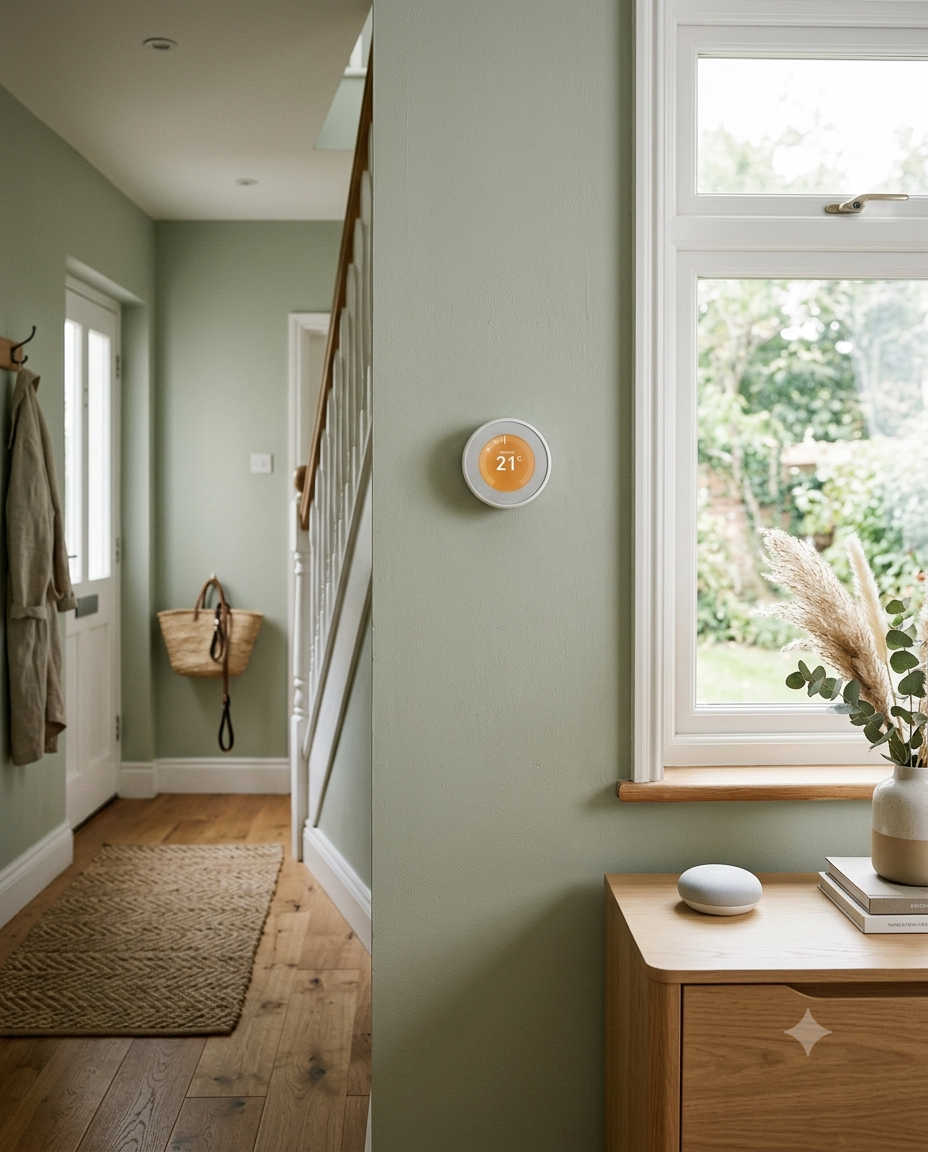
There’s a particular kind of annoyance that comes from asking Siri to turn the heating up and getting nothing back. If HomePods are dotted around your house, your lights already respond to voice commands, and the Home app is basically your smart home’s control tower, a thermostat that can’t join that conversation feels like a weak link. It’s the one device in the house still making you open a separate app.
The reassuring part is that this is a solved problem now, at least for UK homes. Apple HomeKit support in the smart heating category has caught up considerably, and you no longer have to choose between “works with Siri” and “actually cuts my heating bill.” Several thermostats now do both, and do them well.
What still varies enormously, though, is how each one handles the realities of British housing stock — combi boilers, older wiring, terraced houses with awkward pipework. This guide compares the thermostats that genuinely support Apple Home in the UK, what each one is actually good at, and which one makes sense for your particular boiler and budget.
Quick answer: the best HomeKit thermostats for UK homes
If you just want the short version: tado° is the strongest all-round pick for most combi and system boiler homes, thanks to OpenTherm support and reliable geofencing. Hive is the easiest starting point if you’re new to smart heating. Honeywell Home T6R is the one heating engineers tend to recommend. Drayton Wiser wins on price for multi-room zoning. And Eve Thermo is the purist’s pick for households that live entirely inside the Apple ecosystem and want per-radiator control.
The rest of this guide unpacks why, and which of those fits your home.
What “works with Apple HomeKit” actually means
Not all HomeKit compatibility is built the same way, and the difference affects how the thermostat behaves day to day.
Native Matter or Thread support
Some thermostats connect directly to your Apple Home hub over Thread or Wi-Fi, using the Matter standard. This means basic control still works locally even if the manufacturer’s cloud service has a bad day — a real advantage if you’ve ever lost heating control because an app’s servers went down.
Bridge-based support
Other thermostats route through the manufacturer’s own hub, which then exposes a HomeKit integration alongside its Alexa and Google Home integrations. This still works fine in practice, but it adds a dependency: if the brand’s app or cloud service is having issues, your Siri and Home app control can wobble too.
Partial vs full HomeKit control
This is the detail that catches people out. A few brands let the Home app handle basic temperature adjustments and on/off control, while locking scheduling, geofencing or advanced automation behind their own proprietary app. If home automation and scenes are the whole point for you, it’s worth checking exactly what the Home app can and can’t do before buying — not after fitting it to the wall.
The best HomeKit-compatible thermostats for UK homes
tado° — the most complete option for UK boilers
tado° is the thermostat most heating installers and smart home reviewers converge on, and for good reason. On compatible boilers, it supports OpenTherm modulation, which lets the boiler adjust its output gradually rather than just cycling on and off — a genuine efficiency gain that cheaper thermostats can’t replicate. Geofencing is one of the more dependable implementations on the market, and its Weather Adaptation feature pre-heats your home based on forecast conditions rather than a fixed schedule. Apple HomeKit is a first-class integration here, not an afterthought bolted on for a marketing checkbox.
Fitting it is a genuinely manageable DIY job — most people are done in around half an hour on standard UK wiring. tado° also makes smart radiator valves that plug into the same ecosystem, so you can add room-by-room control later without replacing anything. The one thing to budget for: some of the more advanced features sit behind a subscription, so it’s worth pricing that in alongside the hardware cost rather than treating it as a one-off purchase.
Best for: most UK homes with a combi or system boiler that want the strongest overall balance of efficiency, reliability and HomeKit integration.
Hive Active Heating — the low-friction choice
Hive has built its entire reputation on not intimidating first-time buyers, and it delivers on that promise. It’s compatible with the vast majority of UK combi and system boiler setups, works particularly smoothly with Worcester Bosch and Vaillant systems, and the app is about as close to zero learning curve as this category gets. Apple HomeKit, Alexa and Google Assistant are all supported natively, so it’s a sensible option if you haven’t fully committed to one smart home ecosystem yet.
It’s worth knowing its limits, though. Most Hive setups don’t support OpenTherm modulation, so the energy savings are more modest than tado°’s, and geofencing is locked behind the Hive Plus subscription tier. Hive’s own smart radiator valves add individual room control if you want to expand later, but the whole ecosystem is better suited to people who want something that just works than to households chasing granular automation from day one.
Best for: first-time smart heating buyers who want something simple and widely supported, without much setup fuss.
Honeywell Home T6R — the installer’s favourite
Ask a heating engineer which smart thermostat they’d actually put in their own home, and the T6R comes up more often than you’d expect. It doesn’t need a separate hub, has a long track record of just working, and supports OpenTherm alongside HomeKit, Alexa and Google Home. The HW variant adds hot water control on top, which extends its compatibility across a wider range of UK boiler types than most competitors manage.
What it trades away is polish. The geofencing isn’t as refined as tado°’s, and the app is built for function rather than delight — you won’t find the same slick onboarding experience. If what you actually want is a thermostat that a professional trusts and that integrates cleanly with Apple Home without any of the extras you don’t need, it’s a strong and slightly underrated pick.
Best for: buyers who want a no-nonsense, hub-free thermostat with a track record of reliability, particularly if hot water control matters.
Drayton Wiser — the value option for zoned heating
If your main frustration is that one thermostat can’t keep every room at the right temperature, Drayton Wiser is built to solve exactly that, and it does it without the price tag you’d expect. It supports Apple HomeKit alongside the other major platforms and is designed from the ground up around multi-zone control, which makes it a genuinely useful option for larger homes where a single sensor covering the whole house never quite gets the balance right.
It doesn’t try to compete with tado° on scheduling sophistication or weather-based pre-heating, but for straightforward, budget-conscious multi-room control, it’s hard to beat on value.
Best for: larger homes or anyone prioritising per-room zoning over advanced smart scheduling features.
Eve Thermo — for households that are all-in on Apple
Eve Thermo is a different kind of product entirely. Rather than replacing your whole-home thermostat, it’s a smart radiator valve designed specifically for people who live entirely inside the Apple ecosystem and want no compromises on that front. The current generation runs on Thread and Matter, needs nothing beyond a HomePod mini or Apple TV acting as a Thread border router, and keeps everything local — there’s no Eve cloud account, no registration, and no data leaving your home network.
The trade-off is built into the product’s identity: it’s Apple-only, with no meaningful Alexa or Google Assistant support, and on its own it can’t call for hot water the way a full thermostat system can. It works best paired with an existing thermostat, letting you fine-tune individual rooms rather than replacing your whole-home heating control. For anyone who has already ruled out Alexa and Google Home entirely, that narrow focus is exactly the point.
Best for: Apple-only households wanting precise, private, per-radiator control rather than whole-home thermostat replacement.
Why the Google Nest Learning Thermostat isn’t on this list
If you’ve researched HomeKit thermostats in the US, you might expect to see Nest here. It’s deliberately absent: the current Nest Learning Thermostat has never been released in the UK, largely because it isn’t built for typical UK heating wiring or combi boiler configurations. The older Nest models that were sold here don’t offer native Apple HomeKit support either, so it isn’t a genuine like-for-like alternative to the options above, regardless of availability.
How to choose the right one for your home
The honest answer is that “best” depends more on your boiler and household than on any single feature list. If you want the strongest all-round performance and your boiler supports OpenTherm, tado° is the safest bet. And, if you’d rather ease in with something simple and expand later, start with Hive. If you want a thermostat an installer would choose for their own house, look at the Honeywell Home T6R. If your main problem is uneven heating across a bigger property, Drayton Wiser solves that more cheaply than anything else here. And if you’ve already committed fully to Apple and want granular, private, per-room control, Eve Thermo is in a category of its own.
Whichever you lean toward, check boiler compatibility before you check anything else. OpenTherm support, your existing wiring, and whether you have a combi, system or heat-only boiler will narrow this list far faster than comparing app screenshots ever will.
Frequently asked questions
Does Apple HomeKit require a hub for smart thermostats? Basic control usually works without one, but features like geofencing, automations while you’re away, and remote access typically need a HomeKit hub — a HomePod, HomePod mini, or Apple TV.
Can I use a HomeKit thermostat without replacing my existing boiler? Yes. All of the thermostats above are designed to control your existing boiler through its current wiring; none of them require a new boiler.
Is tado° or Hive better for Apple Home users specifically? Both integrate natively with Apple Home, but tado° generally offers deeper HomeKit-accessible features, including geofencing, while Hive’s more advanced features sit behind its own app and subscription tier.
Do smart radiator valves work with a HomeKit thermostat? In most cases, yes — tado° and Eve both sell radiator valves that integrate with their respective ecosystems, letting you set different temperatures per room in addition to whole-home control.